Author William Gibson poses for a portrait at the Last Bookstore in Los Angeles. Photo: Jason Redmond/Wired
One of science fiction’s most visionary and distinctive voices, William Gibson maintains that he and his fellow writers don’t possess some mystical ability to peer into the future.
“We’re almost always wrong,” said Gibson in a phone interview with Wired. Gibson coined the term cyberspace in his 1982 short story “Burning Chrome” and expanded on the concept in his 1984 debut novel, Neuromancer.
Part 2: William Gibson on the Temptation of Twitter, Antique Watches (Coming Friday)
Part 3: William Gibson on Punk Rock, Memes and ‘Gangnam Style’ (Coming Saturday)
In that book, which quickly became a classic, inspiring pop culture and science fiction for decades to come, Gibson predicted that the “consensual hallucination” of cyberspace would be “experienced daily by billions of legitimate operators, in every nation” in a global network of “unthinkable complexity.”
Yet Gibson says he simply got lucky with his prescient depiction of a digital world. “The thing that Neuromancer predicts as being actually like the internet isn’t actually like the internet at all!” said the writer, who has since penned numerous critically acclaimed novels, including Count Zero (1986), Mona Lisa Overdrive (1988), The Difference Engine (co-authored with Bruce Sterling, 1990), Pattern Recognition (2003) and Zero History (2010).
Gibson’s most recent book, a collection of nonfiction called Distrust That Particular Flavor, was published this year; he is currently working on a new novel, tentatively titled The Peripheral.
In this Wired interview, which will be published over the next three days, Gibson discusses a dizzying range of subjects, including antique watches, comic books, punk rock, fortune tellers, internet memes and the long-running plans for a Neuromancer movie. Wired: Do you think the category “science fiction” is useful anymore? Your last few books, like the Blue Ant trilogy, qualify as science fiction, but they’re set in a feasible approximation of present-day reality.
Facebook forced The New Yorker to remove a cartoon depicting Adam and Eve in the Garden because the cartoonist drew in two dots representing Eve's nipples, which is a Facebook no-no.
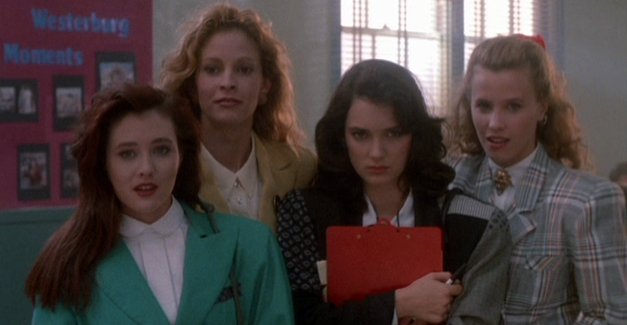
News broke today that Bravo was headed into scripted television territory, and that's the positive news. (Holding out on calling it "good news" until I see the actual shows.) But then there was this: a reboot of the movie Heathers. As you can imagine, the blogosphere (at least the writers who are Heathers fans) was not thrilled about this news. But fortunately, the movie itself has provided a whole slew of reactions for us! Let's take a look at a bunch of quotes from the movie that can now be reissued as pre-reviews of this very dumb reboot idea. The best part is that we don't even need context from the plot!
Tracy King sends us an "animated history of genetics from Nature to celebrate the release of ENCODE. Narrated by Tim Minchin and animated by the team who made Storm. Written by Adam Rutherford (Nature), Andrew Ellard (Red Dwarf, IT Crowd) and Tracy King (TAM London).
In a zombie apocalypse — as everyone knows — the undead eat brains (or other body parts, depending on which mythology you subscribe to). On a film set, however, zombies basically eat Jell-O. Recipes vary, of course, but in Resident Evil: Retribution, out Friday, the walking dead chew on a version fortified with glycerin and sorbitol, compounds often used to make soft-gel pills. Added to gelatin, the combo turns the faux flesh into something solid enough for actors to really sink their rotting bicuspids into. “The stuff is great, because if it accidentally gets ingested, it’s essentially food,” says Paul Jones, a prosthetic makeup designer who created more than 800 zombies for the new movie. “You can actually bite into it and see it tear.” More occipital lobe, anyone?
Recipe: DIY Faux Flesh*
Ingredients:
200 grams glycerin
200 grams sorbitol
100 grams gelatin powder (recommended: 300 bloom)
2.5 grams zinc oxide
Colored face powder
Red and green colored frocking
Water as needed
1. Mix the glycerin and sorbitol together in a large bowl, then add the gelatin powder and zinc oxide. Microwave in 2-minute intervals, stirring until the powder melts into the liquid. (To make skin that can tear more easily, as in a bite wound, replace the sorbitol with water.) 2. Once melted, add desired colored frocking or small amounts of face powder or food coloring, until desired hue is achieved. 3. Pour into food grade silicone mold. (These can be made at home using a kit or purchased from a specialty catalog.) 4. Cool in refrigerator until the mixture sets. Small body parts, such as hands or arms, will cool within a couple of hours. Larger body parts will take longer. Yield: 1 serving of brains, flesh, or viscera
The Soylent Corporation processed human flesh into wafers. The psychos in The Texas Chain Saw Massacre turned their victims into sausage. But people provide the mystery meat in more than just sci-fi and horror movies. They've also been unwittingly consumed in adaptations of Broadway musicals and feel-good tales of female empowerment. How do all the meals compare? Warning: stomach-churning spoilers ahead
Earlier this week, Boston Dynamics demonstrated the capabilities of the Legged Squad Support System (LS3), a semi-autonomous four legged robot designed to serve as a pack mule for US troops (video). The robot can navigate difficult terrain, follow a human leader, and right itself if it falls over. It will eventually have a range of 20 miles, a top speed of 7 MPH, and a cargo capicity of 400 pounds. The robot has another two years of testing and refinement ahead of it before it is deployed in an operational exercise with US Marines. The LS3 project is funded by DARPA and the US Marine Corps.
The other day, a reader asked why I call climate change "climate change", instead of "global warming". The short answer is that, from my perspective, climate change does a much better job of giving people an accurate mental picture of what is going on. Global warming sounds like the world is just going to get hotter, and while that's technically true on a global-average-temperature-basis, it doesn't really reflect what's happening locally
When NASA's Sunita Williams and Japanese astronaut Akihiko Hoshide couldn't seem to get a bolt attached to the outside of the space station, ground crews came up with a clever solution: Fix the problem with a toothbrush. At Space.com, Denise Chow explains the details:
On Aug. 30, Williams and Hoshide completed a marathon spacewalk that lasted more than 8 hours, but the astronauts were thwarted by a stubborn bolt and were unable to finish connecting the so-called main bus switching unit (MBSU). The stuck bolt forced NASA to add [yesterday's] extra spacewalk.
But, following last week's unsuccessful attempt, flight controllers, engineers and veteran spacewalkers worked around the clock at NASA's Johnson Space Center in Houston to devise a solution to the problem. Using only the supplies available on the space station, the teams came up with creative new tools for Williams and Hoshide to use to install the MBSU.
One was a modified toothbrush that was used to lubricate the inside of the bolt's housing after debris and metal shavings from inside had been removed. Another improvised instrument included a cleaning tool that had been made from wires that were bent back to form a brush, explained Kieth Johnson, lead spacewalk director at the Johnson Space Center
Artist Kevin Champeny creates astounding large format artworks that are part mosaic and part sculpture. The finished works look like sculptures or mosaics, but a closer look reveals they are made of hundreds or thousands of tiny objects, often individually cast by the artist. “Flag,” for instance, is an American flag made up of 44,450 urethane army men cast in red, white, and blue. “What Remains” is a five foot wide skull mosaic made up of more than 35,000 tiny flowers. According to Champeny, each work takes several months to complete.
Be sure to play Edgy Comic Bingo, by Cathy Leamy, who creates comics herself and knows a thing or two about getting linked to. Click through for the full NSFW card
The Rise and Fall of The Clash is an upcoming documentary about the influential and short-lived British punk rock band, The Clash (trailer). The film includes previously unseen footage as well as interviews with band members and associates. It is directed by Danny Garcia.
“Scopophilia” (“love of looking”) by artist Fiona Roberts is a red velvet chair that is embedded with hundreds of realistic plastic eyeballs. The chair sculpture was part of Robert’s graduate show at the Helpmann Academy Graduate Exhibition 2012 in Adelaide, Australia
Associated PressHundreds of coal miners and their families wait in line to attend a rally Aug. 14 at the Century Mine near Beallsville, Ohio.
WASHINGTON, D.C. -- When GOP presidential candidate Mitt Romney visited an Ohio coal mine this month to promote jobs in the coal industry, workers who appeared with him at the rally lost pay because their mine was shut down.
The Pepper Pike company that owns the Century Mine told workers that attending the Aug. 14 Romney event would be both mandatory and unpaid, a top company official said Monday morning in a West Virginia radio interview.
A group of employees who feared they'd be fired if they didn't attend the campaign rally in Beallsville, Ohio, complained about it to WWVA radio station talk show host David Blomquist. Blomquist discussed their beefs on the air Monday with Murray Energy Chief Financial Officer Rob Moore.
Moore told Blomquist that managers "communicated to our workforce that the attendance at the Romney event was mandatory, but no one was forced to attend." He said the company did not penalize no-shows.
Because the company's mine had to be shut down for "safety and security" reasons during Romney's visit, Moore confirmed workers were not paid that day. He said miners also lose pay when weather or power outages shut down the mine, and noted that federal election law doesn't let companies pay workers to attend political events.
Moore said he didn't see anything negative in attending Romney's campaign appearance with U.S. Sen. Rob Portman and Ohio Treasurer Josh Mandel.
"We are talking about an event that was in the best interest of anyone that's related to the coal industry in this area or the entire country," Moore said in the radio interview.
When contacted about the interview on Monday afternoon, Murray Energy spokesman Gary Broadbent emailed this statement: "Rob Moore made it abundantly clear that no employees were forced to attend the Romney event. All participation was, and always has been, completely voluntary."
Blomquist said that he got multiple emails and phone calls from Murray Energy workers who felt that they were intimidated into attending Romney's appearance. He said employees were told they'd have to forfeit the day's pay unless they could make up their missed hours on overtime or weekends.
"My whole point is that nobody should be pressured into attending anyone's political event," Blomquist told The Plain Dealer. "If they shut the mine down, why should they lose a day's pay? There are some guys that just want to go to work, feed their family and go home."
Romney used his appearance at the coal mine to blast what he called a "war on coal" by the Obama administration that he said was costing jobs in the coal industry.
"We have 250 years of coal," Romney said. "Why in the heck wouldn't we use it? And so, I want to take advantage of those energy resources."
A Romney campaign spokesman did not respond to a request for comment from The Plain Dealer Monday afternoon.
Was Ray Bradbury a communist sympathizer? A threat to the American way of life? Clark Merrefield digs into the newly obtained FBI files on the celebrated science-fiction writer.
Ray Bradbury, the science-fiction writer who died at age 91 in early June, was the target of FBI investigations over a period spanning more than a decade, according to 40 pages of government documents obtained by a Freedom of Information Act request by The Daily Beast.
Bradbury was born August 22, 1920 in Waukegan, Ill., and enjoyed a literary career spanning eight decades. He is best known for his short stories and the novel Fahrenheit 451, which chronicles Guy Montag, a conflicted protagonist tasked with setting books on fire, and the detached society punctuated by a paranoid government in which Montag lives.
The government in Montag’s world, it turns out, was not so different from the government in Bradbury’s.
The FBI’s investigation of Bradbury in the late 1950s centers on alleged communist activity, and it reveals more about the author’s talent for holding up a dystopian mirror to reflect society’s flaws than actual communist tendencies. These government documents were first obtained by Bradbury biographer Sam Weller and described in his 2005 book The Bradbury Chronicles.
“I remember distinctly his response when I visited him and presented him with the files,” Weller told The Daily Beast. “He beamed ear to ear and dismissed it with a wave of his hand and laughed and he said, ‘I’ll be damned, I’ve had nothing to hide over the years—what are they going to investigate? What a bore.’”
Still, Bradbury was amused. He held the pages to his chest and asked Weller for a copy.
Ray Bradbury. (AP Photo)
Bradbury did not dissuade the government when, in 1952, he took out an advertisement in the trade publication Daily Variety and wrote, according to the documents:
“I have seen too much fear in a country that has no right to be afraid. I have seen too many campaigns in California, as well as in other states won on the issue of fear itself, and not on the facts. I do not want to hear any more of this claptrap and nonsense from you. I will not welcome it from McCARTHY or McCARRAN, from Mr. NIXON, DONALD JACKSON, or a man named SPARKMAN. I do not want any more lies, any more prejudice, any more smears. I do not want intimations, hearsay or rumor. I do not want unsigned letters or nameless telephone calls from either side, or from anyone.”
Bradbury got exactly what he didn’t want. The FBI investigation of Bradbury spans April 2 through June 3, 1959, and included surveillance from special agents.
“There’s some case notes to indicate they were parked outside the street of his house, watching his house. There were definitely agents stationed, watching his family and the goings on at the Bradbury home,” Weller says.
According to Martin A. Berkeley, a former member of the Communist Party and one of few named sources in the files, Bradbury, “was probably sympathetic with certain pro-Communist elements in the WGAw [Writers Guild of America, West].” He told the FBI that during a meeting of the Writers Guild, formerly the Screen Writers Guild, the union was considering whether to keep Communist Party members from joining, and Bradbury rose up and shouted, “Cowards and McCarthyites.”
At times the files venture into a sort of detached literary criticism, likely aimed at elucidating Bradbury’s worldview. Of Bradbury’s short-story collection The Martian Chronicles, which according to the documents sold over 200,000 copies in its second edition, special agent John S. Temple writes, “The stories were connected by the repeated theme that earthmen are despoilers and not developers.”
Bradbury may have been an inconvenient public figure to some, but the FBI ultimately concluded, “No evidences have been developed which indicate he was ever a member of the CP.”
Roughly 10 years after its initial investigation, the FBI again trained its sights on Bradbury regarding a suspected trip to Cuba to attend the Cultural Congress of Havana, a conference meant to “obtain unity of action in the anti-imperialist fight and in defense of the cultural nucleus of each country.”
Bradbury’s suspected interest in the Cultural Congress appears to stem from a confusion over a tip about a “Roy Bradbury.” Bradbury’s passport file was ultimately investigated. The FBI connected with two unnamed informants during the third and fourth weeks of July 1968, and another informant during the second week of August 1968, to attempt to nail down a link between Bradbury and Cuba.
One informant editorialized that “Bradbury would be a type person [sic] who might be invited to attend the Cultural Congress of Havana because of his liberal view,” but none of the sources could provide the FBI with any usable information.
“The files were so sloppy they called him Raymond at points in there—that’s not even his legal name,” Weller says.
The FBI decided it would be imprudent to continue their investigation and speak with him directly: “Due to Bradbury’s background as a known liberal writer, vocal in anti-United States war policies, an interview with Bradbury would be deemed unadvisable.”
Bradbury ultimately found resigned humor in the time and resources wasted on investigating his normal American life.
“The files were so sloppy they called him Raymond at points in there—that’s not even his legal name,” Weller says
Mitt Romney's campaign has paid rock band Journey $500,000 to play at a private campaign event, TMZ reports.
A source tells the entertainment website that the campaign hired
the group to play a 90-minute set at a Tampa, Fla. fundraising event on
Thursday night. The Republican National Convention comes to a close
that evening.
Romney's campaign did not immediately return a request for comment.
As the Tampa Bay Times
reported, Journey is slated to perform at Liberty Plaza, a tented
concert space. Kid Rock and Trace Adkins are also scheduled to perform
at private events during the convention.
Bill Nye makes a plea for teaching our children science and preparing them to make good choices for the future.
When Did the GOP Get So White: The Republicans’ Loss of Diversity
The one-time Party of Lincoln boasted the first African-American, Asian-American, Native-American, Hispanic, and popularly-elected woman senators. Now polls show Romney-Ryan will get virtually no black votes. John Avlon looks at the party’s inclusivity retreat.
Of course, this doesn’t mean that no African-Americans will vote for the Romney-Ryan ticket, just that it will be within the margin of error and along the lines last time, when McCain-Palin somehow managed to score 4 percent of the black vote.
But ’twas not always thus for the GOP. Dust off your history books and you will see Republicans once had a virtual lock on the minority vote—and minority elected officials. The legacy of Lincoln was alive and well until not so long ago. Which makes the retreat of recent decades both unfortunate and ill-timed.
Consider that the first popularly-elected African-American senator was a Republican, Ed Brooke from Massachusetts, in 1966. Likewise the first Asian-American senator, Hawaii’s Hiram Fong, who was first elected in the Eisenhower era. The first Native-American senator, Charles Curtis—who went on to be Herbert Hoover’s vice president. The first Hispanic senator, Octaviano Larrazolo, also was a Republican. Ditto the first woman popularly elected to the Senate, Maine’s Margaret Chase Smith.
“The Republican Party was the party that gave hope and inspiration to minorities—and there was a coalition at first,” says Ed Brooke, now 92 and living with his wife, Anne, in Miami. “My father was a Republican. My mother was a Republican. They wouldn't dare be a Democrat. The Democrats were a party opposed to civil rights. The South was all Democratic conservatives. And the African-American community considered them the enemy.”
That’s why every single one of the 23 African-American members of Congress before 1900 was a Republican. They wouldn’t have dreamed of being anything other than members of the Party of Lincoln—Democrats were the party of the Confederate South. Frederick Douglass summed up the sentiment when he said, “I am a Republican, a black, dyed-in-the-wool Republican, and I never intend to belong to any other party than the party of freedom.” This legacy echoed for generations.
“When I first went to the Senate there was one woman there, Margaret Chase Smith, who was a Republican,” remembers Brooke. “Of course, I was the only African-American. But there were a couple of Jewish senators—Jacob Javits [a Republican from New York] and Abe Ribicoff [a Democrat] from Connecticut. We had some diversity—racial diversity and [gender] diversity—but it was very small, of course. But we also had a degree of diversity as far as political ideology. We had a group of moderate senators who met for lunch once a week and we had a block of eight that usually voted together on these issues.”
Clockwise, from top left: Frederick Douglass, the first popularly-elected African-American Senator Republican Edward Brooke, the first Asian-American Senator, Hawaii’s Hiram Fong, and Senator Hayakawa.
The decline of centrist Republicans was one important reason for the decline in the GOP’s diversity over recent decades, according to Brooke. The shift of the party’s political base to the states of the former Confederacy coincided with the rise of social conservatism and states’ rights in what had been the progressive party in the era of Lincoln. The historic irony of a Southern Democrat, Lyndon Johnson, signing civil rights and voting rights bills into law (which his 1964 opponent Barry Goldwater opposed) solidified the shift of African-Americans into the Democrats’ camp, capped by the election of the first African-American president a half-century later.
Demographics are destiny, and looking like the party of old white men is not a recipe for Republican success in the future.
“When you say Republican Party to the average citizen now, what comes up in their minds?” asks Brooke. “Not that it was the first party to elect an African-American to the United States Senate or the first woman. And then Hiram Fong and [S.I] Hayakawa, representing Hawaii and California. There were all these instances where Republicans were first. But they never really were able to capitalize on that. They always looked like they wanted to keep that hidden. If the Democrats had done that, we would have never stopped hearing about it.”
Demographics are destiny, and looking like the party of old white men is not a recipe for Republican success in the future. That’s why this forgotten legacy of diversity should be respected and celebrated, even as the Party of Lincoln has turned into the Party of Reagan. Because these forgotten figures deserve to be remembered by Republicans and all Americans as the pioneers they were.
Oh, my lovelies, wait until you hear about this so you can throw all your money at it like fairy dust: Adan Jodorowsky, son of avant garde filmmaker Alejandro Jodorowsky (who almost made Dune with Salvador Dali and Orson Welles), and Asia Argento, daughter of Dario Argento (Suspiria, Inferno), are both filmmakers in their own right, and are currently collaborating on a short, surrealist film called The Voice Thief. With the help of some interested parties, they hope to raise funds for the movie on Kickstarter. Here are some details about the film:
"[A] mad husband attempts to steal voices for his opera singing wife, who's since lost hers... Adan describes the journey as involving 'a prostitute dwarf who still lives as a child in the shadow of her mother’s corpse,' and 'a cult that worships a giant transvestite who drips gold from her vagina.'"
I'm sorry, but if that doesn't sound like something we all can't get behind in these divided times, I don't know what is. But seriously, this sounds like an ambitious and deliciously weird project being made by people with wonderful imaginations. And if Jodorowsky can find a way to bypass the studios and make this the way he wants, then that's excellent!
Jodorowsky will be directing Argento, who will be playing the mute opera singer, and his brother Cristobal, who is playing the voice-stealing husband. Their deadline is September 14, so visit their Kickstarter page to read more about the production and what you'll get if you donate.
We interrupt our regularly scheduled blog to bring you a brief moment during which I will fantasize in public about having an extra $25,000 lying around so I could pre-order one of these Devon Steampunk watches
By Dana Milbank, Published: August 22The Washington Post
When Todd Akin sneezes, Paul Ryan catches a cold.
The Republicans’ soon-to-be nominee for vice president is supposed to be delivering a message about jobs and the economy, but he’s finding he cannot escape his longtime House colleague, now a national pariah for his exotic views on rape.
“His statements were outrageous, over the pale. I don’t know anybody who would agree with that. Rape is rape, period, end of story,” Ryan told Pittsburgh’s KDKA-TV in the first in a series of local TV interviews.
Except it wasn’t the end of the story. The questions were just beginning.
“Rape is rape. Rape is rape, period. End of story,” Ryan replied to another query.
“Rape is rape, and there’s no splitting hairs over rape,” he answered yet again.
Ryan is surely aching to talk about something other than Akin. But the outrage set off by the Republicans’ Senate nominee in Missouri has consumed the political world. It has been particularly harmful to Ryan, who has served for more than a decade with Akin, recently hailing him as “a great asset” on Ryan’s budget committee and an example of “exactly the kind of leadership America needs.”
More problematic in this situation: Ryan has the same antiabortion position as Akin — no exceptions — and some of the nearly 40 abortion bills he has co-sponsored have provided no exemption for rape victims.
This is more random bad luck for Mitt Romney, who has had more than his share in recent days. His running mate, chosen for his green-eyeshade savvy, has unexpectedly become a lightning rod in the culture wars, in an area where Republicans are at a decided disadvantage. Only 20 percent of Americans agree with Ryan and Akin that abortion should be illegal in all cases, according to a Gallup poll in May.
Akin, in an interview Wednesday morning with NBC’s Matt Lauer, confirmed that Ryan had called to try to push him from the race after his “legitimate rape” remark and his fanciful claim that women’s bodies could reject the sperm of rapists. “He felt that I had to make a decision, but he advised me that it would be good for me to step down,” said Akin, who rebuffed Ryan.
“It’s as you would imagine,” Ryan said when asked aboard his campaign plane later for his version of the call. “And I’ll keep it between us.” Ryan repeated his view that Akin “should’ve dropped out of the race, but he’s not. He’s going to run his campaign. We’re going to run ours.”
Would he call Akin again?
“I have no plans to,” the candidate said.
Surely Ryan would like to call Akin all kinds of colorful things for throwing Republicans badly off message on the eve of their convention. Romney, party officials and even Rush Limbaugh have called for him to quit. Akin’s dwindling list of supporters is down to a motley assortment of abortion hard-liners who applaud his no-exceptions stance.
Ryan has already surrendered that position. “Look, I’m proud of my record,” he told reporters on his plane, but “Mitt Romney is going to be president, and the president sets policy. His policy is exceptions for rape, incest and life of the mother. I’m comfortable with it because it’s a good step in the right direction.”
Does he now regret his sponsorship of legislation that made a distinction between “forcible rape” and other kinds — a position eerily similar to Akin’s “legitimate rape”?
“That bill passed, I think, by 251 votes,” Ryan replied. “It was bipartisan.” He neglected to mention that it passed after removal of the “forcible” language.
The candidate tried to guide the reporters back to friendlier topics. “This is fantastic,” he said of his brief time on the trail. “The encouragement from the crowds is just amazing. It’s an infectious enthusiasm.”
Perhaps, but that’s not the dominant strain infecting Ryan’s candidacy at the moment.
Collector of anomalies, esoterica, and curiosities. On Instagram, I'm @pescovitz
BB pal Adam Savage of MythBusters liked using antique leather doctor's bags to hold his tools. But the bags couldn't handle the 50+ pounds of tools that he needed while working at Industrial Light and Magic. So he remade the bags out of aluminum and added scissor lifts for easy reach. "The finished boxes housed everything I needed, but I repeatedly rebuilt the insides until finally no tool had to be moved out of the way to get to another," Adam wrote in Wired. "That’s first-order retrievability
Paul Ryan wants to kill all tax on capital gains, interest, and dividends -- income you get from owning things, rather than doing a job. Under this plan, Mitt Romney's $21,000,000 in 2010 income would be largely tax-exempt. Only his speaking and author fees -- $593,996 -- would be taxed, and only at 25%, for a net tax of $177,650 on $21,661,344 -- that is, 0.82%.
Thai artist Witit Karpkraikaew has imagined Disney princesses as undead brain-eaters in this series that shows Snow White, Ariel and Cinderella as gruesome zombies.
Paul Ryan, Ayn Rand Fan, Brings Writer's Philosophy To Presidential stage....
WASHINGTON -- When Republican presidential candidate Mitt Romney selected Rep. Paul Ryan (R-Wis.) as his running mate, he wasn't just picking a self-proclaimed nerd and policy wonk, he was picking Ayn Rand's latest and best literary agent.
Rand's windy, melodramatic prose has been a conservative and libertarian inspiration for decades. Her novels "Atlas Shrugged" and "The Fountainhead" are deemed essential philosophical tracts in defense of capitalism and the will of the individual over a society based on shared sacrifice. Rand titled one of her books "The Virtue of Selfishness."
In a recent New Yorkerprofile, Ryan called her a key inspiration in his life. His coming-of-age moment featured Rand.
"I grew up on Ayn Rand," Ryan told the Atlas Society, a group of Rand devotees, in a 2005 speech. "That's what I tell people ... you know, everybody does their soul-searching, and trying to find out who they are and what they believe, and you learn about yourself ... I grew up reading Ayn Rand, and it taught me quite a bit about who I am and what my value systems are, and what my beliefs are."
Ryan went on to say that Rand's works are required reading for his staff. "The reason I got involved in public service, by and large, if I had to credit one thinker, one person, it would be Ayn Rand," he went on to say. "And the fight we are in here, make no mistake about it, is a fight of individualism versus collectivism."
Rand's works featured prominently in a 2009 Ryan video critique of President Barack Obama. The congressman said that he was not surprised that Rand's novels have spiked in popularity since Obama took office. "It's that kind of thinking, that kind of writing that is sorely needed right now," Ryan said. "And I think a lot of people would observe that we are right now living in an Ayn Rand novel, metaphorically speaking."
In April, Ryan attempted to distance himself from his prior infatuation with the novelist, telling the National Reviewin an interview, "If somebody is going to try to paste a person's view on epistemology to me, then give me Thomas Aquinas. Don't give me Ayn Rand." (A spokesman later suggested that Ryan was not repudiating Rand's philosophy, but that Ryan did not make staffers read "Atlas Shrugged.")
Rand followers are apparently overjoyed at Romney's choice of Ryan as his vice presidential pick.
"I think the announcement is great news," Aaron Day, CEO of the Atlas Society, told Politico. "[T]he influence of Rand on Ryan as it relates to the role and nature of government is a huge step forward for the liberty movement."
This program tells the story of the making of this landmark release through new interviews with Roger Waters, David Gilmour and Nick Mason and archive interviews with the late Richard Wright. Also featured are sleeve designer Storm Thorgerson, guest vocalist Roy Harper, front cover burning man Ronnie Rondell and others involved in the creation of the album. Original recording engineer Brian Humphries revisits the master tapes at Abbey Road Studios to illustrate aspects of the songs construction.
Bonus Features: The Blu-ray contains additional bonus material not featured in the TV broadcast version, including further interviews with Roger Waters, David Gilmour and Nick Mason plus Roger Waters and David Gilmour performing excerpts from the Wish You Were Here album.









 BB pal Adam Savage of MythBusters liked using antique leather doctor's bags to hold his tools. But the bags couldn't handle the 50+ pounds of tools that he needed while working at Industrial Light and Magic. So he remade the bags out of aluminum and added scissor lifts for easy reach. "The finished boxes housed everything I needed, but I repeatedly rebuilt the insides until finally no tool had to be moved out of the way to get to another," Adam


 This cantilevered clear-bottomed swimming pool is on the 24th floor of the Holiday Inn Shanghai Pudong Kangqiao

