Debbie Cook was in for only 7 weeks in 2007, but her experience was brutal. She testified that Miscavige had two hulking guards climb into her office through a window as she was talking to him on the phone. "Goodbye" he told her as she was hauled off to the gulag. Like Rinder, she described a place where dozens of men and women were confined to what had been a set of offices. Cook testified that the place was ant-infested, and during one two-week stretch in the summer with temperatures over 100 degrees, Miscavige had the air conditioning turned off as punishment. Food was brought up in a vat riding on a golf cart. Cook described it as a barely edible "slop" that was fed to them morning, noon, and night. Longtime residents of the Hole began to look gaunt. They had to find places on the floor or on desks to sleep at night. Rinder said there were so many of them they slept only inches from each other, and having to get up in the middle of the night was a nightmare of stepping over sleeping figures in the dark. In the morning, they were marched out of the offices and through a tunnel under Gilman Springs Road to a large building with communal showers. They were then marched back to the Hole, and during the day would be compelled to take part in mass confessions. During these, Rinder says people he had considered friends would put on a show for the officials overseeing them, trying to outdo each other with vile accusations against each other. Cook testified that Miscavige wanted Marc Yager and Guillaume Lesevre, two of his longest-serving and highest-ranking officials, to confess to having a homosexual affair. The men were beaten until they made some forced admissions. When Cook objected to what was happening, she herself was made to stand in a trash can for twelve hours while insults were hurled at her, she was called a lesbian, and water was dumped on her head.
Coming to Kindle and Smashwords

November 2013
Aug 9, 2012
Scientology's "Hole" - alleged torture-camp for high-ranking execs who fell out of favor

Aug 8, 2012
Andrea Saul, Romney Spox, Gets Pilloried For Mentioning Candidate's Most Important Achievement

So, it's come to this. Today, a spokeswoman for Mitt Romney responded to an attack ad disseminated by a super PAC supporting President Barack Obama. The ad was a controversial broadside, worthy of a response. The spokeswoman spoke against the ad with conviction. She offered a counter argument that was precise and logical and fair. The spokeswoman cleanly invoked her candidate's greatest legislative achievement, in an eminently reasonable way, in her candidate's defense.
And that spokeswoman's response is being hailed as one of the 2012 campaign season's most collossal cock-ups.
In 2006, Soptic's wife passed away, and a future attack ad was born.
In the immediate aftermath of the ad's deployment, the Romney camp issued a relatively standard response, referring to the ad as dishonest and accusing the president and his allies of using such attacks to distract from economic issues. And nothing more might have come of this had Romney's team stuck to that story.
The thing is, though, Saul's logic in citing Romney's creation and implementation of CommonwealthCare in Massachusetts is impeccable. Her baseline argument: If you are going to hit Romney with the Bain practices that allegedly led to this woman losing her health insurance, you surely must credit him for his legislative accomplishments, which enabled thousands of uninsured people to obtain life-saving care. That is, for the most part, pristine reasoning.
The only problem, of course, is that this wasn't offered in 2008, when it would have been hailed as a brilliant defense. We've once again come face to face with the perplexing weirdness at the center of Romney's entire presidential effort: in 2012, Romney is not allowed to run on the singular achievement of his career -- Massachusetts health care -- that earned him a spot in the world of GOP presidential contenders in the first place.
I've said this before: for all of the grief that Romney has taken for his multitude of flip-flops over the years, those are not, collectively, as damaging to Romney's ambition as the way the Republican Party has flopped on him. In 2008, RomneyCare was held to be an accomplishment with edge -- he'd neatly co-opted a key Democratic Party plank, universal health care, and delivered it to his constituents, using the individual mandate concept dreamed up by the conservative Heritage Foundation. Coupled with his time spent rescuing the Salt Lake City Olympics, Romney had reason to brag about his managerial acumen and problem-solving ability.
But after Romney's idea got re-co-opted by the Obama administration, Romney became another victim of the vagaries of tribal politics, which dictated that anything that even vaguely resembled ObamaCare was now anathema. Romney has tried to manage this mess by explaining away his own accomplishment as something that he never envisioned being imposed by the federal government. That argument hasn't gained much traction, probably because people essentially remember that his health care accomplishment was front-and-center during his 2008 run.
And that spokeswoman's response is being hailed as one of the 2012 campaign season's most collossal cock-ups.
Sigh. Here's what happened. This week, Priorities USA Action, a super PAC run by former Obama advisor Bill Burton (who is surely not "coordinating" his efforts with the Obama campaign, because that would be tsk-tsk illegal!) put out a brutal attack ad. It tied the activities of Bain Capital to the death of a woman who lost her health care coverage as a result of her husband losing his job at GST Steel, one of the celebrated casualties of Bain's business practices. As Alex Burns reported:
The commercial casts Mitt Romney’s business background in a severely negative light, but it's not a typical slash-and-burn attack ad. Instead, it features former GST Steel employee Joe Soptic speaking to the camera about what happened when the plant where he worked shut down. "I don't think Mitt Romney understands what he's done to people's lives by closing the plant. I don't think he realizes that people's lives completely changed," Soptic said. “When Mitt Romney and Bain closed the plant, I lost my health care and my family lost their health care. And a short time after that my wife became ill.”
In 2006, Soptic's wife passed away, and a future attack ad was born.
In the immediate aftermath of the ad's deployment, the Romney camp issued a relatively standard response, referring to the ad as dishonest and accusing the president and his allies of using such attacks to distract from economic issues. And nothing more might have come of this had Romney's team stuck to that story.
But on Fox News this morning, Romney spokeswoman Andrea Saul went "off-script," and amid a larger declaration about the ad being despicable and some pushback on the facts of the ad, she offered this statement in Romney's defense: "To that point, if people had been in Massachusetts, under Governor Romney's health care plan, they would have had health care."
After that came the deluge of conservatives savaging Saul for getting lost on the road to Damascus, essentially accusing her of giving away the election. The thing is, though, Saul's logic in citing Romney's creation and implementation of CommonwealthCare in Massachusetts is impeccable. Her baseline argument: If you are going to hit Romney with the Bain practices that allegedly led to this woman losing her health insurance, you surely must credit him for his legislative accomplishments, which enabled thousands of uninsured people to obtain life-saving care. That is, for the most part, pristine reasoning.
The only problem, of course, is that this wasn't offered in 2008, when it would have been hailed as a brilliant defense. We've once again come face to face with the perplexing weirdness at the center of Romney's entire presidential effort: in 2012, Romney is not allowed to run on the singular achievement of his career -- Massachusetts health care -- that earned him a spot in the world of GOP presidential contenders in the first place.
I've said this before: for all of the grief that Romney has taken for his multitude of flip-flops over the years, those are not, collectively, as damaging to Romney's ambition as the way the Republican Party has flopped on him. In 2008, RomneyCare was held to be an accomplishment with edge -- he'd neatly co-opted a key Democratic Party plank, universal health care, and delivered it to his constituents, using the individual mandate concept dreamed up by the conservative Heritage Foundation. Coupled with his time spent rescuing the Salt Lake City Olympics, Romney had reason to brag about his managerial acumen and problem-solving ability.
But after Romney's idea got re-co-opted by the Obama administration, Romney became another victim of the vagaries of tribal politics, which dictated that anything that even vaguely resembled ObamaCare was now anathema. Romney has tried to manage this mess by explaining away his own accomplishment as something that he never envisioned being imposed by the federal government. That argument hasn't gained much traction, probably because people essentially remember that his health care accomplishment was front-and-center during his 2008 run.
And if the reaction to Saul's statement proves anything, it's that the tribe has only become less inclined toward Romney's health care law. The fury, in this instance, was led by Red State founder Erick Erickson, who earnestly tweeted: "OMG. This might just be the moment Mitt Romney lost the election. Wow." Ever since then, he's been blogging about Saul's statement as if it were a massive disaster, assuring his readers that "Mitt Romney’s ardent supporters are fit to be tied today." Rush Limbaugh has since piled on, telling his listeners that "Andrea Saul's appearance on Fox was a potential gold mine for Obama."
The sentiments being expressed by Erickson and Limbaugh, it should be noted, are not universal. Erickson himself has written about some of the negative reaction to his remarks, and while no one he cites defends Saul, there are apparently some who are giving Erickson grief about his outsized reaction. Erickson, however, haughtily dismisses these concerns:
Mitt Romney Lost the Summer: Tax Returns, Overseas Gaffes, & More
Labor Day is weeks away, but the battle of the summer is over—and Obama won. Robert Shrum on the unreleased tax returns, easily foreseen Bain attacks, Olympic stumbles, inept tax plan, and other calamities that sank Romney.
After the worst foreign excursion of any presidential hopeful since his father visited Vietnam and announced afterward that he was “brainwashed,” trippy Mitt found no surcease of sorrow in an unwelcome return home.

The first blow came from a brace of polls. The Pew Research Center showed Romney suddenly behind Barack Obama by 10 points, with the president above the crucial 50 percent mark. Quinnipiac/CBS/New York Times surveys in Florida, Ohio, and Pennsylvania had Obama hitting or exceeding that mark, with leads between 6 and 11 percent. The underlying numbers were more ominous for Romney. His favorable/unfavorable, already underwater in Pew’s June numbers, collapsed from -6 to -15. No nominee in either party has entered the final phase of the race so tarnished in the American mind.
Republicans assailed the Pew and Quinnipiac polls with the fervor they usually reserve for inconvenient truths about climate change or the Affordable Care Act. But while they can quibble with figures, the overall lay of the swing-state land is clear. On Aug. 1, The New York Times’ Nate Silver had the president ahead in every one of his 10 “tipping-point states.”
The problem with Romney isn’t just what the Obama campaign has done to him, but what he has done to himself. Months ago, as he struggled through the GOP primaries, we learned in the debates and in his days on the trail, and he should have learned it too, that he can’t trust his mouth. From “I’m also unemployed” to the $10,000 bet—the list is legion—Romney blurted out a discordant symphony of tone-deaf proof that he was out of touch and perhaps out of his depth. He instinctively says the wrong thing.
As the debate over Romney’s taxes rages, Peter Beinart and Dan Gross discuss whether his returns are even relevant.
A prudent campaign would corral the candidate, scheduling practice and more practice, and abjuring spontaneity. The latter wouldn’t sacrifice anything anyway, as scripted or not, he sounds like Romney the robot. It’s doubtful that he can’t memorize, but it’s indisputable that he can’t tell a joke. When he tries, the joke is generally on him. And it’s political malpractice for his political handlers to let him, or for him to insist on breaching the bounds of his buttoned-down persona. Richard Nixon found this out the hard way in 1960, and eight years later, in his second run for the White House, he was tightly contained, sanitized, and successfully resistant to any debate with his opponent Hubert Humphrey.
very,very good..............
The new video for "Hell Broke Luce," the best track on Tom Waits's outstanding recent album Bad As Me is every bit as kick-ass as it should be. Directed by Matt Mahurin


Aug 3, 2012

Share Better
Jul 30 2012
Watching Romney Ignore This Dying Man's Plea Is Really Upsetting

Not to get too melodramatic here, but does this look like someone with the leadership ability to be president? This was probably about as awkward for everyone in the room as an eighth-grade dance, but somehow I expect more from a person expecting to run a country.
ORIGINAL: By YouTube user
Debt, Depression, DeMarco
There has been plenty to criticize about President Obama’s handling of the economy. Yet the overriding story of the past few years is not Mr. Obama’s mistakes but the scorched-earth opposition of Republicans, who have done everything they can to get in his way — and who now, having blocked the president’s policies, hope to win the White House by claiming that his policies have failed.

Paul Krugman
And this week’s shocking refusal to implement debt relief by the acting director of the Federal Housing Finance Agency — a Bush-era holdover the president hasn’t been able to replace — illustrates perfectly what’s going on.
Some background: many economists believe that the overhang of excess household debt, a legacy of the bubble years, is the biggest factor holding back economic recovery. Loosely speaking, excess debt has created a situation in which everyone is trying to spend less than their income. Since this is collectively impossible — my spending is your income, and your spending is my income — the result is a persistently depressed economy.
How should policy respond? One answer is government spending to support the economy while the private sector repairs its balance sheets; now is not the time for austerity, and cuts in government purchases have been a major economic drag. Another answer is aggressive monetary policy, which is why the Federal Reserve’s refusal to act in the face of high unemployment and below-target inflation is a scandal.
But fiscal and monetary policy could, and should, be coupled with debt relief. Reducing the burden on Americans in financial trouble would mean more jobs and improved opportunities for everyone.
Unfortunately, the administration’s initial debt relief efforts were ineffectual: Officials imposed so many restrictions to avoid giving relief to “undeserving” debtors that the program went nowhere. More recently, however, the administration has gotten a lot more serious about the issue.
And the obvious place to provide debt relief is on mortgages owned by Fannie Mae and Freddie Mac, the government-sponsored lenders that were effectively nationalized in the waning days of the George W. Bush administration.
The idea of using Fannie and Freddie has bipartisan support. Indeed, Columbia’s Glenn Hubbard, a top Romney adviser, has called on Fannie and Freddie to let homeowners with little or no equity refinance their mortgages, which could sharply cut their interest payments and provide a major boost to the economy. The Obama administration supports this idea and has also proposed a special program of relief for deeply troubled borrowers.
But Edward DeMarco, the acting director of the agency that oversees Fannie and Freddie, refuses to move on refinancing. And, this week, he rejected the administration’s relief plan.
Who is Ed DeMarco? He’s a civil servant who became acting director of the housing finance agency after the Bush-appointed director resigned in 2009. He is still there, in the fourth year of the Obama administration, because Senate Republicans have blocked attempts to install a permanent director. And he evidently just hates the idea of providing debt relief.
Mr. DeMarco’s letter rejecting the relief plan made remarkably weak arguments. He claimed that the plan, while improving his agency’s financial position thanks to subsidies from the Treasury Department, would be a net loss to taxpayers — a conclusion not supported by his own staff’s analysis, which showed a net gain. And it’s worth pointing out that many private lenders have offered the very kinds of principal reductions Mr. DeMarco rejects — even though these lenders, unlike the government, have no incentive to take into account the way debt relief would strengthen the economy.
The main point, however, is that Mr. DeMarco seems to misunderstand his job. He’s supposed to run his agency and secure its finances — not make national economic policy. If the Treasury secretary, acting for the president, seeks to subsidize debt relief in a way that actually strengthens the finance agency, the agency’s chief has no business blocking that policy. Doing so should be a firing offense.
Can Mr. DeMarco be fired right away? I’ve been seeing conflicting analyses on that point, although one thing is clear: President Obama, if re-elected, can, and should, replace him through a recess appointment. In fact, he should have done that years ago. As I said, Mr. Obama has made plenty of mistakes.
But the DeMarco affair nonetheless demonstrates, once again, the extent to which U.S. economic policy has been crippled by unyielding, irresponsible political opposition. If our economy is still deeply depressed, much — and I would say most — of the blame rests not with Mr. Obama but with the very people seeking to use that depressed economy for political advantage.
Famous Movie Character’s Outfits, Test Your Film Fashion Knowledge

Test your film fashion knowledge with these photos of outfits made famous by the movies. Try to match each carefully laid outfit with a men’s movie character. The shots were taken by photographer Candice Milon for a spread in French men’s magazine Sport & Style.






via thaeger and Flavorwire
images via thaeger from photos
Hand-Cranked Wooden Shell Game Machine
By on August 2, 2012

Swedish artist Per Helldorff built this ingenious hand-cranked mechanical wooden sculpture of a con man conducting a shell game. The sculpture is one of many mechanical devices on display at Helldorff’s
Aug 2, 2012
Will Wright on life on Mars, 2047
david pescovitz
Collector of anomalies, esoterica, and curiosities. On Instagram, I'm @pescovitz Air & Space Smithsonian invited Sims creator Will Wright to imagine the first communities on Mars. Here's an excerpt from his vision of Marstown, population 8,000, in 2047:
 Like most colonists, Sasha had made the decision to move to Mars for the sake of her descendants. Seeing only limited opportunities on Earth and having a strong sense of adventure and duty, she had been captivated by the ratification of the Mars Development Treaty of 2032. Dwindling natural resources and massive environmental disruption had encouraged politicians on Earth to look to Mars as a long-term lifeboat, another foothold for humanity in the face of an uncertain future. The Mars Treaty essentially privatized about half of the Martian surface, rewarding those willing to relocate there with huge plots of land. While that land was nearly worthless today, the hope they all carried was that one day it would be a valuable legacy to pass on to their children and grandchildren. Sasha was in the third wave of colonists; the first group of 500 had been transported to Mars eight years earlier. The colony now numbered about 8,000, the primary limits to the population being the cost of transportation from Earth—which was covered by the Mars Development Corporation (MDC)—and the extent of the hydroponic gardens within the tube complex. The MDC represented a consortium of investors from national governments and international funds (vying for long-term territorial and mineral rights) and individual billionaires (with more idealistic motives
Amazing Large Scale Charcoal Drawings by Robert Longo

Artist Robert Longo creates astonishingly vivid large scale charcoal drawings, many of which exceed seven feet at their largest dimension. Longo created his first major series of drawings, “Men in Cities,” back in 1979. An upcoming book, Robert Longo: Charcoal, features highlights from the past 20 years of his career. Longo is also a film director—he has directed a number of music videos and the sci-fi film Johnny Mnemonic.









KFC Loves Gays, John Goodman Plays a Gay-Lovin’ Colonel Sanders
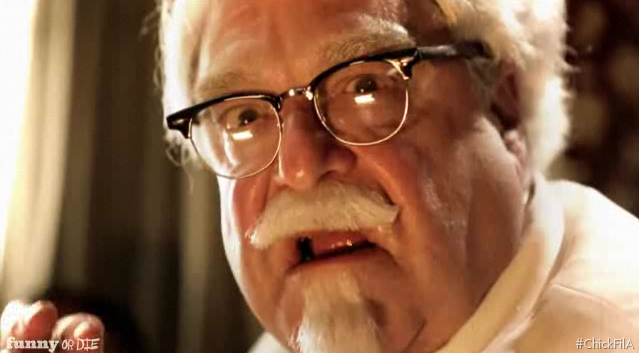
Comedy site Funny or Die takes on the recent Chick-fil-A/same-sex marriage controversy with KFC Loves Gays, a brilliant parody KFC ad starring actor John Goodman as a gay-lovin’ Colonel Sanders. The video humorously paints KFC as the pro-gay alternative to anti-gay restaurant Chick-fil-A, suggesting that the Colonel himself is gay
Perhaps you thought General Butt Naked in "Book of Mormon" was a fictional character? You thought wrong.
Today known as Joshua Blahyi, he devotes himself to running a ministry, making amends, and rehabilitating former child soldiers. In his former life he ran the Butt Naked Brigade, a militia aligned with Samuel Doe. There were countless militias in those days, led by men who adopted noms de guerre such as General Bin Laden and General Mosquito. Butt Naked’s soldiers were particularly ruthless—killers and rapists who fought naked except for guns and shoes. Their nakedness was meant to instill fear and, they also thought, to protect them. By their own admission, before battle they often sacrificed young children, ate their hearts, and drank their blood. “The hearts were roasted,” Blahyi told me, as if that were a mitigating detail. In 2008, in front of Liberia’s Truth and Reconciliation Commission, he claimed that he and his followers had killed more than 20,000 people
HOWTO survive a robot uprising (just add water)
HOWTO survive a robot uprising (just add water)
Cory Doctorow
Lexington, Brooklyn, Brookline, Rochester
 Randall "XKCD" Munroe's "What If?" site continues to shine -- and possibly even to outshine his most excellent webcomic. This week, Randall (whose background is in robotics), looks at what would happen in a robot uprising. He's rather sanguine about this, given the general uselessness of robots in the field.
 Those robots lucky enough to have limbs that can operate a doorknob, or to have the door left open for them, would have to contend with deceptively tricky rubber thresholds before they could get into the hallway... Hours later, most of them would be found in nearby bathrooms, trying desperately to exterminate what they have identified as a human overlord but is actually a paper towel dispenser... Battlebots, on the face of it, seem like they’d be among the most dangerous robo-soldiers. But it’s hard to feel threatened by something that you can evade by sitting on the kitchen counter and destroy by letting the sink overflow.
Aug 1, 2012
Mitt Romney Tax Plan Helps The Rich The Most: Analysis

* Romney tax plan cuts 20 percent for all income groups
* Those making over $1 million benefit most under plan
* Romney hasn't spelled out how to fund tax cuts
By Kim Dixon
WASHINGTON, Aug 1 (Reuters) - Republican U.S. presidential challenger Mitt Romney's proposal to slash individual income taxes by 20 percent across-the-board would primarily boost the income of the wealthiest taxpayers, according to a nonpartisan analysis released on Wednesday.
The report by the centrist Tax Policy Center found that Romney's tax cuts would boost after-tax income by an average of 4.1 percent for those earning more than $1 million a year, while reducing by an average of 1.2 percent the after-tax income of individuals earning less than $200,000.
Tax policy and how to tame the U.S. government's budget deficit, topping $1 trillion in recent years, is a major point of contrast in the presidential race, in which Romney will face President Barack Obama on Nov. 6.
Romney, a multi-millionaire who made his fortune at private equity firm Bain Capital, has not spelled out how he would lower marginal tax rates. But he has said broadly he would cut some tax benefits for the wealthy.
Because the value of the 20 percent tax cut for richer Americans would exceed the gains they get from popular tax breaks that Romney would chop, they would see the greatest income gain from Romney's possible changes, the study said.
"We add up how much people get from the tax cuts and then add up how much can be potentially be raised," from ending tax breaks, said Adam Looney, an economist and one of the study's authors.
About two-thirds of the $1.1 trillion in revenues that the government foregoes annually because of tax breaks would have to be curbed to fund Romney's tax cut, the analysts said.
These tax breaks include popular ones such as the mortgage interest deduction, the break for employer-provided health insurance, and credits for low- and middle-income families.
The analysis assumed elimination of tax breaks would start with the wealthy as Romney has suggested, and it assumed some revenue growth from lower tax rates, a hallmark of Republican tax policy.
Obama has blasted Romney's tax plan for disproportionately benefiting the wealthy.
The tax policy debate is expected to intensify at the end of 2012, with the expiration of lower tax rates for all Americans enacted under Republican President George W. Bush.
The Democratic-led Senate last week passed legislation extending most of those tax rates - but not for households earning more than $250,000 a year.
The Republican-led House of Representatives will likely pass their plan to extend the current rates some time this week.
The dispute is not likely to be resolved until after the elections.
Romney spokeswoman Amanda Henneberg said she could not respond to the center's report without reading it first.
Romney's tax proposal also includes cutting some taxes on investment income and eliminating taxes on estates passed on to heirs. (Reporting by Kim Dixon; Editing by Kevin Drawbaugh and Lisa Shumaker)
Subscribe to:
Posts (Atom)