News broke today that Bravo was headed into scripted television territory, and that's the positive news. (Holding out on calling it "good news" until I see the actual shows.) But then there was this: a reboot of the movie Heathers. As you can imagine, the blogosphere (at least the writers who are Heathers fans) was not thrilled about this news. But fortunately, the movie itself has provided a whole slew of reactions for us! Let's take a look at a bunch of quotes from the movie that can now be reissued as pre-reviews of this very dumb reboot idea. The best part is that we don't even need context from the plot!
Tracy King sends us an "animated history of genetics from Nature to celebrate the release of ENCODE. Narrated by Tim Minchin and animated by the team who made Storm. Written by Adam Rutherford (Nature), Andrew Ellard (Red Dwarf, IT Crowd) and Tracy King (TAM London).
In a zombie apocalypse — as everyone knows — the undead eat brains (or other body parts, depending on which mythology you subscribe to). On a film set, however, zombies basically eat Jell-O. Recipes vary, of course, but in Resident Evil: Retribution, out Friday, the walking dead chew on a version fortified with glycerin and sorbitol, compounds often used to make soft-gel pills. Added to gelatin, the combo turns the faux flesh into something solid enough for actors to really sink their rotting bicuspids into. “The stuff is great, because if it accidentally gets ingested, it’s essentially food,” says Paul Jones, a prosthetic makeup designer who created more than 800 zombies for the new movie. “You can actually bite into it and see it tear.” More occipital lobe, anyone?
Recipe: DIY Faux Flesh*
Ingredients:
200 grams glycerin
200 grams sorbitol
100 grams gelatin powder (recommended: 300 bloom)
2.5 grams zinc oxide
Colored face powder
Red and green colored frocking
Water as needed
1. Mix the glycerin and sorbitol together in a large bowl, then add the gelatin powder and zinc oxide. Microwave in 2-minute intervals, stirring until the powder melts into the liquid. (To make skin that can tear more easily, as in a bite wound, replace the sorbitol with water.) 2. Once melted, add desired colored frocking or small amounts of face powder or food coloring, until desired hue is achieved. 3. Pour into food grade silicone mold. (These can be made at home using a kit or purchased from a specialty catalog.) 4. Cool in refrigerator until the mixture sets. Small body parts, such as hands or arms, will cool within a couple of hours. Larger body parts will take longer. Yield: 1 serving of brains, flesh, or viscera
The Soylent Corporation processed human flesh into wafers. The psychos in The Texas Chain Saw Massacre turned their victims into sausage. But people provide the mystery meat in more than just sci-fi and horror movies. They've also been unwittingly consumed in adaptations of Broadway musicals and feel-good tales of female empowerment. How do all the meals compare? Warning: stomach-churning spoilers ahead
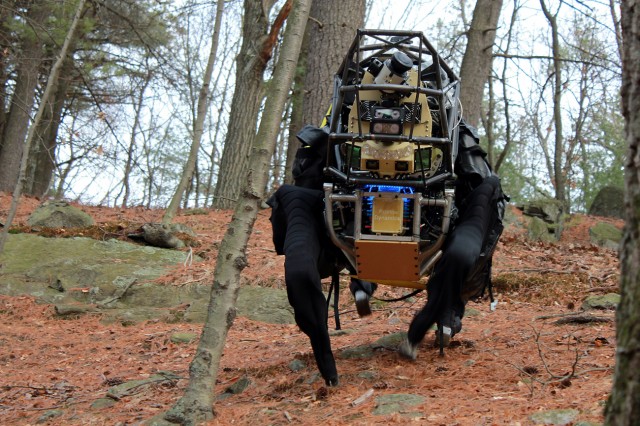
Earlier this week, Boston Dynamics demonstrated the capabilities of the Legged Squad Support System (LS3), a semi-autonomous four legged robot designed to serve as a pack mule for US troops (video). The robot can navigate difficult terrain, follow a human leader, and right itself if it falls over. It will eventually have a range of 20 miles, a top speed of 7 MPH, and a cargo capicity of 400 pounds. The robot has another two years of testing and refinement ahead of it before it is deployed in an operational exercise with US Marines. The LS3 project is funded by DARPA and the US Marine Corps.
The other day, a reader asked why I call climate change "climate change", instead of "global warming". The short answer is that, from my perspective, climate change does a much better job of giving people an accurate mental picture of what is going on. Global warming sounds like the world is just going to get hotter, and while that's technically true on a global-average-temperature-basis, it doesn't really reflect what's happening locally
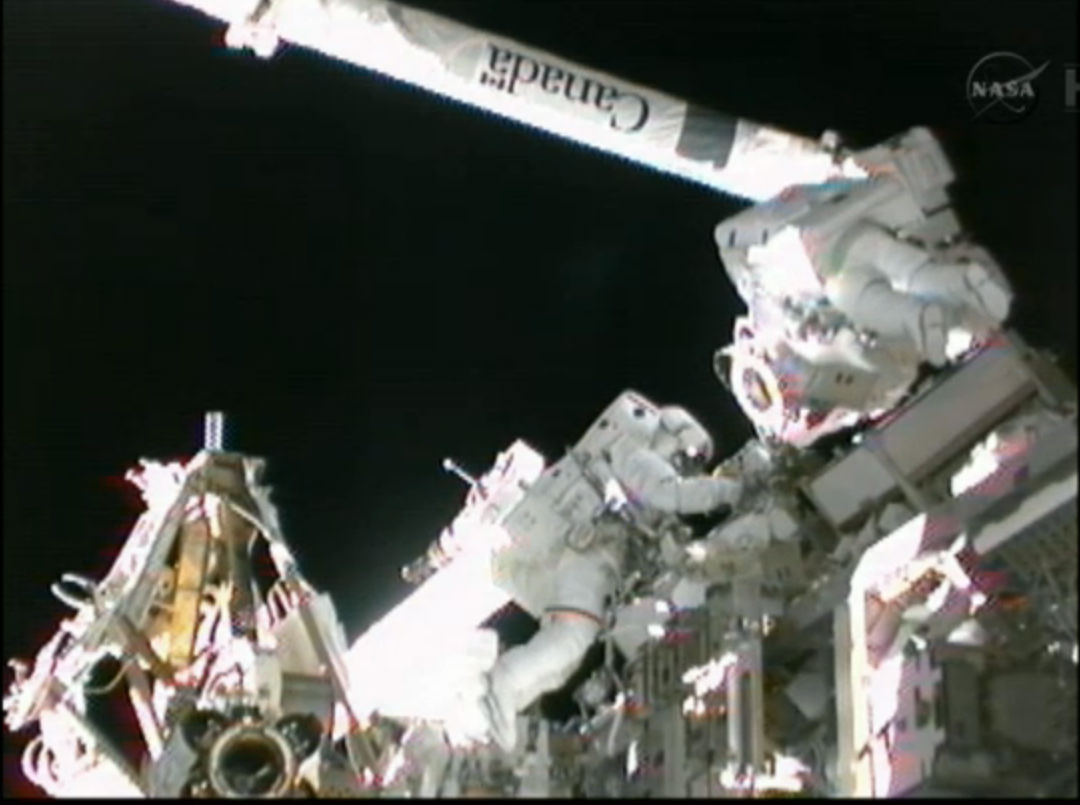
When NASA's Sunita Williams and Japanese astronaut Akihiko Hoshide couldn't seem to get a bolt attached to the outside of the space station, ground crews came up with a clever solution: Fix the problem with a toothbrush. At Space.com, Denise Chow explains the details:
On Aug. 30, Williams and Hoshide completed a marathon spacewalk that lasted more than 8 hours, but the astronauts were thwarted by a stubborn bolt and were unable to finish connecting the so-called main bus switching unit (MBSU). The stuck bolt forced NASA to add [yesterday's] extra spacewalk.
But, following last week's unsuccessful attempt, flight controllers, engineers and veteran spacewalkers worked around the clock at NASA's Johnson Space Center in Houston to devise a solution to the problem. Using only the supplies available on the space station, the teams came up with creative new tools for Williams and Hoshide to use to install the MBSU.
One was a modified toothbrush that was used to lubricate the inside of the bolt's housing after debris and metal shavings from inside had been removed. Another improvised instrument included a cleaning tool that had been made from wires that were bent back to form a brush, explained Kieth Johnson, lead spacewalk director at the Johnson Space Center
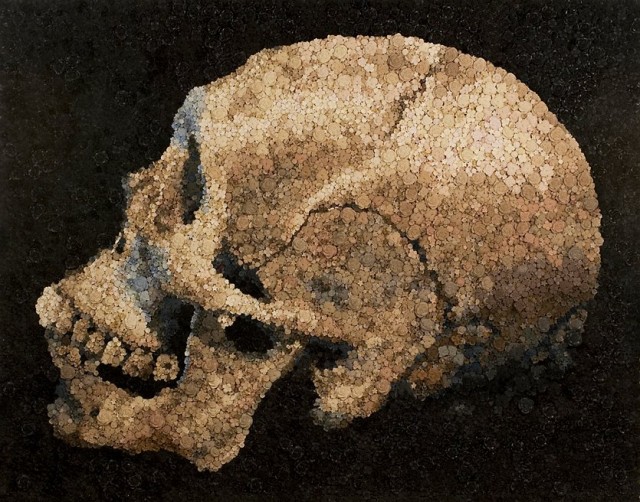
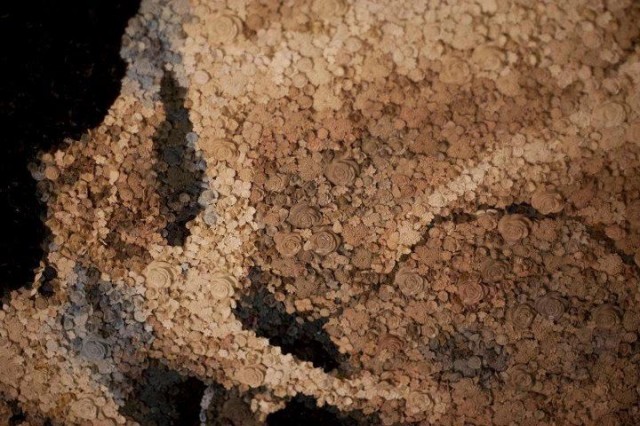
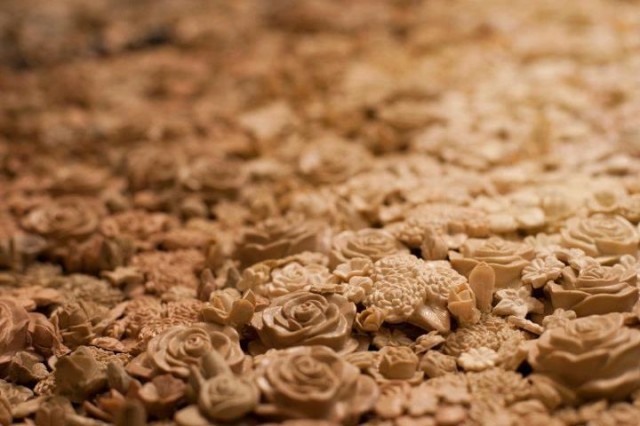
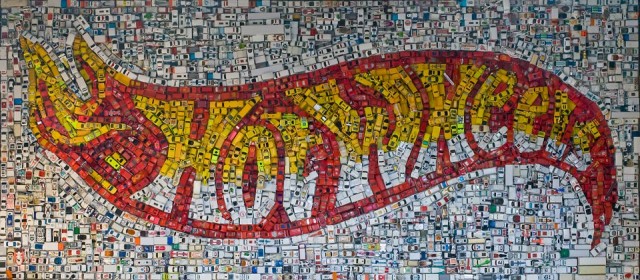
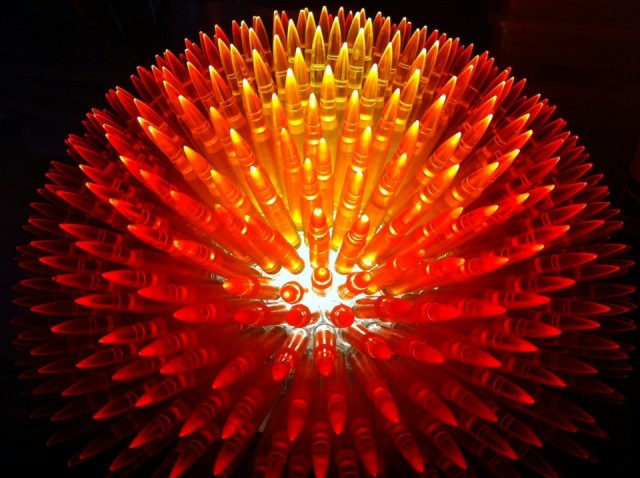
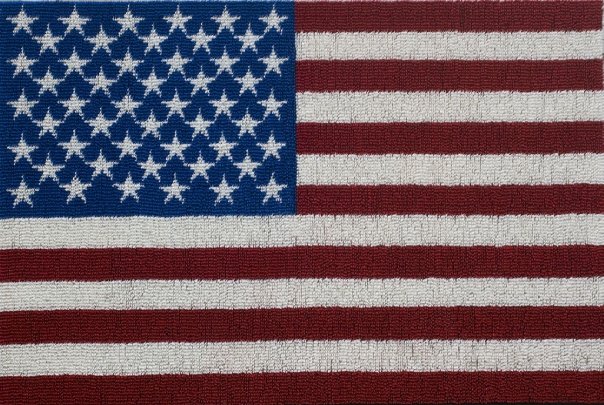
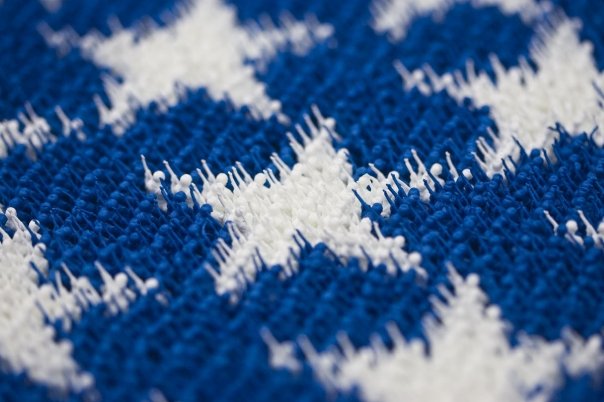
Artist Kevin Champeny creates astounding large format artworks that are part mosaic and part sculpture. The finished works look like sculptures or mosaics, but a closer look reveals they are made of hundreds or thousands of tiny objects, often individually cast by the artist. “Flag,” for instance, is an American flag made up of 44,450 urethane army men cast in red, white, and blue. “What Remains” is a five foot wide skull mosaic made up of more than 35,000 tiny flowers. According to Champeny, each work takes several months to complete.
Be sure to play Edgy Comic Bingo, by Cathy Leamy, who creates comics herself and knows a thing or two about getting linked to. Click through for the full NSFW card
The Rise and Fall of The Clash is an upcoming documentary about the influential and short-lived British punk rock band, The Clash (trailer). The film includes previously unseen footage as well as interviews with band members and associates. It is directed by Danny Garcia.
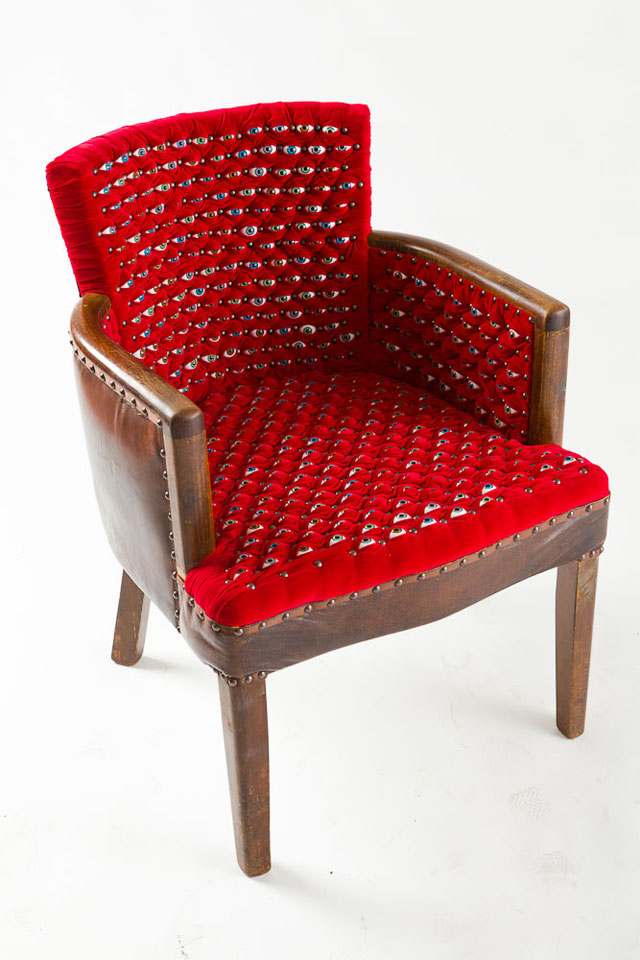
“Scopophilia” (“love of looking”) by artist Fiona Roberts is a red velvet chair that is embedded with hundreds of realistic plastic eyeballs. The chair sculpture was part of Robert’s graduate show at the Helpmann Academy Graduate Exhibition 2012 in Adelaide, Australia