“Thru Tokyo” is a fantastic music video remix of the sights and sounds of Tokyo by musician and video artist Kutiman. The video features a cadre of Japanese musicians, including Nobumichi Tosa of art group Maywa Denki playing the Otamatone. The video is the first in a series of original shorts produced by PBS Digital Studios. We’ve posted a number of Kutiman’s wonderful remixes over the years
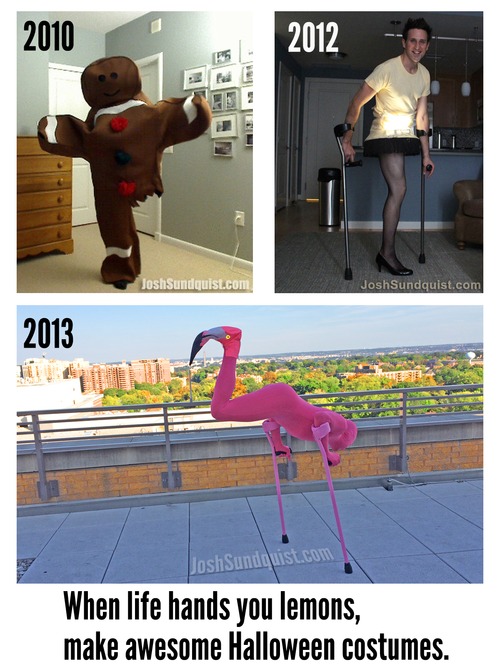
As a boy, Josh Sundquist was diagnosed with a rare form of bone cancer and after a year of chemotherapy treatments, his left leg was amputated. By the age of 13, he was cured of the cancer and later in 2006, became a member of the U.S. Paralympic Ski Team. Off and on for the past few years, Josh has made clever Halloween costumes for himself highlighting the “lemons” he was handed. In 2010, he was a partially eaten Gingerbread man with a “broken off” leg and in 2012, he dressed like the Leg Lamp from A Christmas Story. This year he has really outdone himself by donning a pink Lycra bodysuit and hoisting himself up on arm crutches to become a flamingo. Inspiring!
Here he is talking about his popular costumes, including the flamingo:
In "Fixing Breaking Bad," a disgruntled visual effects artist on the series shows how he could have improved Breaking Bad, if only that meddlesome Vince Gilligan had stayed out of his way
Denis Villeneuve has created Next Floor, a short film about a grotesque and gluttonous feast that falls from floor to floor as its participants shovel food into their mouths
In 2012, ScienceForum created a trippy video of optical illusions designed to produce natural hallucinogenic effects after viewing. I can attest that watching the video does, in fact, trigger temporary dizzying effects (they seem to go away in about five minutes). Be sure to view it in HD and in fullscreen to start the wild optical ride
Every piece of evidence we have so far on the government shutdown shows the public is blaming Republicans most of all for the standoff. On Monday, an ABC poll showed 71 percent fault the GOP; 61 percent fault Congressional Democrats; 51 percent fault President Obama.
Yes, Democrats look bad. Yes, Obama is probably doing himself no favors by saying he won’t negotiate when the public wants politicians in Washington to work together.
But Republicans look considerably worse. And for the Right, the Republican Party is the only game in town.
This is what my fellow conservatives who are acting as the enablers for irresponsible GOP politicians seem not to understand. They like this fight, because they think they’re helping to hold the line on ObamaCare and government spending. They think that they’re supported by a vast silent majority of Americans who dislike what they dislike and want what they want.
I dislike what they dislike. I want what they want. But I fear they are very, very wrong about the existence of this silent majority, and that their misperception is leading them to do significant damage to the already damaged Republican “brand.” (Forgive me for making use of that horribly overused term, but it’s the only one that fits.)
The belief that the public is with them is based on two data points: First, twice as many people say they’re conservative as say they are liberal. And second, ObamaCare is viewed unfavorably by a majority of the American people.
Both are true.
But it has been true for more than 20 years that Americans are twice as likely to call themselves conservative — and in that time Republicans have lost the popular vote in five out of six national elections. The statistic tells us little about how Americans vote or what they vote for.
And it is true that, according to Real Clear Politics, Americans disapprove of ObamaCare, 51 percent to 40 percent. It is unpopular. But it is not wildly, devastatingly unpopular — though given the fact that it is now rolling out and appears to be as incompetently executed as it was badly conceived, it may yet become so.
If ObamaCare had been as unpopular as conservatives believed, their plan for the shutdown — that there would be a public uprising to force Democratic senators in close races in 2014 to defund it — would’ve worked. It didn’t. Not a single senator budged.
Their tactic failed, and now what they are left with is House Speaker John Boehner basically begging the president of the United States to negotiate with him.
One thing we know for sure is that it’s not an equal fight, this fight between a man who received 65 million votes nationwide and a man who received 246,000 votes in one congressional district in Ohio.
Meanwhile, Boehner is basically the face of the US Congress in the eyes of the public. John Boehner is also the effective head of the Republican Party. And the US Congress is viewed favorably by . . . 11 percent of Americans.
Eleven percent.
When I interact with these conservatives, they say they don’t care about the GOP; what they care about are conservative ideas.
They’re right not to assign special glory or power to a political organization and to hold ideas above party. But here’s the condundrum: There is only one electoral vehicle for conservative ideas in the United States — the Republican Party.
It’s one thing to refuse to waste your time buffing and polishing the vehicle so that it looks nice and pretty; that’s what political hacks do, and ideologues have every right to disdain such frippery.
But if, in the guise of making the vehicle function better, you muck up the engine, smash the windshield, put the wrong tires on it and pour antifreeze in the gas tank, you are impeding its forward movement. You’re ruining it, not repairing it.
It may not have been a very good vehicle in the first place, and you may think it couldn’t drive worse, but oh man, could it ever. And it’s the only one you’ve got
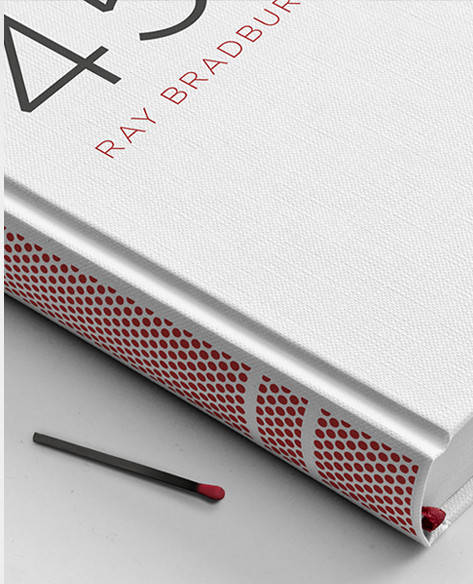
Elizabeth Perez's concept design for an edition of Ray Bradbury's Fahrenheit 451 features a strike-anywhere match set into the cover and a screen-printed striking surface on the spine, so you can use the book to set fire to itself. This Fahrenheit 451 design would make a great accompaniment to the asbestos-bound first edition.
Fahrenheit 451 is a novel about a dystopian future where books are outlawed and firemen burn any house that contains them. The story is about suppressing ideas, and about how television destroys interest in reading literature.I wanted to spread the book-burning message to the book itself. The book's spine is screen-printed with a matchbook striking paper surface, so the book itself can be burned
Oct 8, 2013
Seven Habits of Highly Ineffective Political Parties
When it comes to major policy battles since 2009, the GOP is 0-3. Before it fails again, David Frum offers up seven ways the party is shooting itself in the foot.
Republicans have lost three major fights since 2009. They seem likely soon to lose a fourth—and all in the same way.
The three previous losses (in case you’re feeling forgetful) were, in order:
Chris O'Meara/AP
(1) The fight over Obamacare. Result: the most ambitious new social insurance program since Medicare, financed—unlike Medicare—by redistributive new taxes on investment and high incomes.
(2) The 2012 election. Result: Despite the worst economy since the Great Depression, the re-election of President Obama, Democratic retention of the Senate, and 1.4 million more votes cast for House Democrats than for House Republicans.
(3) The fight over the “fiscal cliff” at the end of 2012. Result: In order to preserve some of the Bush tax cuts, Republicans for the first time since 1991 left their finger prints on a tax increase for upper income groups.
Now comes fight (4), the fight over the government shutdown and the debt ceiling. This one isn’t lost yet. But unless Republicans are prepared to push the country into the catastrophe of national bankruptcy sometime around October 17, it’s hard to see how this one does not end in a Republican retreat, clutching whatever forlorn fig leaf they can negotiate from President Obama.
Behind all four defeats can be seen the same seven mistakes: what you might call the seven habits of highly ineffective political parties. Let’s call the roll:
Habit 1:Maximalist goals.
There’s a lot about Obamacare for a Republican not to like. But to demand Obamacare’s outright repeal (which is what “defunding” amounts to) barely 10 months after decisively losing an election in which Obamacare occupied a central place—well, that’s shooting for the moon. we’ve seen equivalent moon shots again and again since 2009. During the original Obamacare legislation, Republicans took the position: no, no, not one inch. During the election of 2012, Republicans were not content merely to replace one president with another. They also campaigned on the most radical platform the party since 1964. They wanted the biggest possible mandate. Instead they got whomped.
Habit 2:Apocalyptic visions.
Republicans have insisted on maximal goals because they fear they face a truly apocalyptic moment: An irrevocable fork in the road, with one path leading to socialist tyranny, the other to the restoration of the constitutional republic. There sometimes are such moments in history of nations. This is not one. If the United States has remained a constitutional republic despite a government guarantee of healthcare for people over 65, it will remain a constitutional republic with a government guarantee of healthcare for people under 65. Obamacare will cost money the country doesn’t have, and that poses a serious fiscal problem. But it’s not as serious a fiscal problem as is posed by the existing programs, Medicare and Medicaid, which cover the people it costs most to cover. It’s not a problem so serious as to justify panic.
Yet panic has gripped the Republican rank-and-file since 2009—and instead of allaying panic, Republican leaders have aggravated and exploited it, to the point where the leaders are compelled to behave in ways they know to be irrational. In his speech to the “Bull Moose” convention of 1912, Teddy Roosevelt declared, “We stand at Armageddon and we battle for the Lord!” It’s a great line, but it’s not a mindset that leads to successful legislative outcomes.
Habit 3:Irrational animus.
Barack Obama was never likely to be popular with the Republican base. It's not just that he's black. He’s first president in 76 years with a foreign parent—and unlike Hulda Hoover, Barack Obama Sr. never even naturalized. While Obama is not the first president to hold two degrees from elite universities—Bill Clinton and George W. Bush did as well—his Ivy predecessors at least disguised their education with a down-home style of speech. Join this cultural inheritance to liberal politics, and of course you have a formula for conflict. But effective parties make conflict work for them. Hate leads to rage, and rage makes you stupid. Republicans have convinced themselves both that President Obama is a revolutionary radical hell-bent upon destroying America as we know it and that he's so feckless and weak-willed that he'll always yield to pressure. It's that contradictory, angry assessment that has brought the GOP to a place where it must either abjectly surrender or force a national default. Calmer analysis would have achieved better results.
Habit 4:Collapse of Leadership.
The Republicans have always been the more disciplined of America’s two political parities, and today they still are. But whereas before, discipline used to flow from elected leadership down, today it flows from factional leadership up. An aide to Senator Mike Lee told the National Review: “The minority of the minority is going to run things until our leadership gets some backbone.” The Lee aide was specifically referring to the Republican minority in the Senate, but the language has broader implication. According to Robert LaCosta, a well-sourced reporter at NRO: “What we’re seeing is the collapse of institutional Republican power…The outside groups don’t always move votes directly but they create an atmosphere of fear among the members [of Congress].” Large organizations are inherently vulnerable to capture by tightly organized militant tendencies. This is how a great political party was impelled to base a presidential campaign on the Ryan plan—a plan which has now replaced the 1983 manifesto of the British Labour Party as “the longest suicide note in history.” It’s the job of leadership to remember, in the words of Edmund Burke, “Because half-a-dozen grasshoppers under a fern make the field ring with their importunate chink, whilst thousands of great cattle, reposed beneath the shadow of the British oak, chew the cud and are silent, pray do not imagine that those who make the noise are the only inhabitants of the field.” That job is tragically going undone in today’s GOP.
Habit 5:Self-reinforcing media.
The actor Hugh Grant once bitterly characterized his PR team as “the people I pay to lie to me.” Politicians do not always need to tell the truth, but they always need to hear it. Yet hearing the truth has become harder and harder for Republicans. It takes a very unusual spin artist to remember that what he or she is saying isn’t actually true. Non-politicians say what they believe. Politicians sooner or later arrive at the point where they believe what they say. They have become prisoners of their own artificial reality, with no easy access to the larger truths outside. This entombment in their own artificial reality was revealed to the entire TV-watching world in Karl Rove’s Fox News election night outburst against the Ohio 2012 ballot results. It was the same entombment that blinded Republicans to the most likely outcome of their no-compromise stance on Obamacare—and now again today to the most likely outcome of the government shutdown/debt ceiling fight they started.
Habit 6:Politics as war.
The business of America is business, as Calvin Coolidge said. American politics has been businesslike too. They understand that the business of the nation is ultimately settled by a small roomful of tired people negotiating their differences in the small hours of the morning: everybody gets something, nobody gets everything. It’s a grubby business, unavoidably, and most of the time, Americans understand that. They build statues to Martin Luther King. They elect Lyndon Johnson.
From time to time in American politics, differences arise that are too wide to negotiate. Slavery vs. no slavery. Prohibition vs. drink. Pro-life vs. pro-choice. Professional politicians usually keep their distance from absolutist movements. As George Washington Plunkitt observed, “The politicians have got to stand together this way or there wouldn’t be any political parties in a short time.” That line was meant as a joke, but it contains truth. Professional politicians are disagreement managers. Since 2009, however, the GOP has given unprecedented scope to those who for their own ideological, financial, or psychological reasons refuse to allow disagreements to be managed—and instead relentlessly push toward the kind of ultimate crises the country so nearly escaped in 2011 and teeters again on the verge of today.
Habit 7:Despair.
The great British conservative historian Hugh Trevor Roper scoffed at the Marxist claim that history runs in one direction only. “When radicals scream that victory is indubitably theirs, sensible conservatives knock them on the nose. It is only very feeble conservatives who take such words as true and run round crying for the last sacraments.” The great conservative poet TS Eliot explained that there are no lost causes, because there are no won causes. How many ways can one express that idea? So long as there is life, there is hope; everything old is new again; etc. etc. etc.
The trouble with these assurances, however, is that they contain an implicit moral that politics is very hard work. Free-market economics—so discredited in the 1940s—returned to favor in the 1970s because of tireless research by brilliant economists. The excesses of the 2000s have undone that success, and now it will take serious thinking, and some necessary reforms, to repair the damage. It’s a tempting shortcut to throw up one’s hands and say, “I’ve seen the best of it. The future holds only darkness.” It’s especially tempting for a party that disproportionately draws its support from older voters. The fact is that for those of us over 50, the future offers us as individuals only decline leading to extinction. It’s natural to believe that what happens to us must happen to the world around us. Who wants to hear that things will become much, much better for humanity shortly after we ourselves shuffle off the scene? Yet of all mental errors, despair is the most dangerous to a democracy. The “politics of cultural despair” lead to authoritarianism and worse, as the German historian Fritz Stern warned in his history of that same title.
The man who has no hope will make the most irrevocable errors—and unnecessarily plunging the United States into the first national bankruptcy since the 1780s would be about as irrevocable as an error as history contains.
- See more at: http://www.thedailybeast.com/articles/2013/10/08/seven-habits-of-highly-ineffective-political-parties-part-one.html#sthash.AYD8uSHq.dpuf
Street artist Banksy has released a mysterious video entitled “Rebel rocket attack,” which looks rather convincingly like video from a Middle Eastern war zone
Ark Nova is a 500-seat concert hall that can be packed up and transported thanks to its inflatable structure—according to its creators, the Ark Nova is the world’s first mobile inflatable concert hall. It measures 98 feet by 118 feet and features a rounded, organic design by British sculptor Anish Kapoor and Japanese architect Arata Isozaki. The hall was commissioned by the Swiss Lucerne Festival as a way to bring concerts and performances to areas of Japan that were affected by the 2011 Tohoku earthquake and tsunami. Ark Nova was officially unveiled at the Lucerne Festival Ark Nova 2013 in Matsushima on September 27, 2013. The festival runs through October 13, 2013.
photos via
The side of the political divide wearing tin-foil hats..
Getty Images
That many Americans believe strange things is not surprising, but Public Policy Polling reports today that when it comes to embracing odd conspiracy theories, the political divide matters.
PPP's latest round of conspiracy-theory related questions finds that Republicans are more likely than Democrats to believe various government-related conspiracy theories, similar to results we found on our first round of conspiracy polling last April.
If you want to maintain some degree of confidence in rank-and-file Republican voters, you may not want to read further:
* 62% of Republicans believe the Obama administration is secretly trying to take everyone's guns away;
* 44% of Republicans believe President Obama is secretly trying to figure out a way to stay in office beyond January 2017;
* 42% of Republicans fear Sharia Law making its way into America's courts
* 21% of Republicans believe that the U.S. government engages in so-called "false flag" operations, where the government plans and executes terrorist or mass shooting events;
* 27% of Republicans think a group of world bankers are slowly eliminating paper currency to force most banking online -- only to cut the power grid so regular citizens can't access money and are forced into worldwide slavery.
The Open Hand Project aims to make advanced prosthetic hands more accessible to amputees. The Dextrus hand is the realization of this goal, it’s a low-cost robotic hand that offers much of the functionality of a human hand. Ultimately, these hands will be sold for under $1000 (£630).
The Open Hand Project is open-source, which means all of the plans to make a robotic hand will be published online with no patents, anyone has the right to make their own and even sell it themselves.

















 This
This